Top 10 Household Water Filtration System
We may earn a commission for purchases made using our links. Please see our disclosure to learn more.
A household water filtration system should solve a problem you actually have. Cloudy water with visible grit calls for a different filter than unpleasant chlorine taste. A well with measurable iron needs a different approach again.
This guide compares whole-house systems with filters dedicated to drinking water, so you can decide where treatment belongs, what each product does, and what it costs to maintain. Start with your utility’s water report or a recent well-water test. Then check the exact model’s documented claims before you buy.
Our Top Picks
| Product | Best for | Key feature | Our rating |
| iSpring WGB32B | General whole-house filtration | Sediment and carbon stages | ★★★★★ |
| Aquasana Rhino EQ-1000 | Long-life whole-house setup | Large-capacity carbon system | ★★★★⯪ |
| Express Water WH300SCKS | Three-stage filtration | Separate sediment, carbon, and KDF media | ★★★★⯪ |
| Home Master HMF3SDGFEC | Certain well-water concerns | Sediment, iron-focused, and carbon stages | ★★★★⯪ |
| iSpring WGB32BM | Moderate iron concerns | Dedicated iron and manganese stage | ★★★★⯪ |
| Culligan WH-HD200-C | Budget sediment prefiltration | Clear, heavy-duty housing | ★★★★☆ |
| 3M Aqua-Pure AP904 | Easier cartridge changes | Quick-change cartridge | ★★★★⯪ |
| APEC ROES-50 | Drinking and cooking water | Under-sink reverse osmosis | ★★★★★ |
| Waterdrop G3P600 | Compact under-sink RO | Tankless design | ★★★★⯪ |
| AquaTru Classic | Countertop drinking water | RO without plumbing changes | ★★★★⯪ |
Top 10 Household Water Filtration System Options
1. iSpring WGB32B — Best Overall Whole-House Starting Point

For a home with sediment and chlorine-related taste or odor, the WGB32B is a sensible first system to consider. Its three large cartridges provide sediment and carbon filtration at the point where water enters the house, covering showers and appliances as well as faucets.
You’ll need room for the housings and enough clearance beneath them for cartridge changes. Check the exact configuration before ordering: multiple stages do not automatically mean the system reduces lead, hardness, or every chemical.
Key features: Three-stage design with 20-inch sediment and carbon cartridges
Best for: Municipal-water homes seeking general whole-house filtration
Pros: Treats water throughout the home; replaceable cartridges; practical starting point
Cons: Requires plumbing work and utility-room space
Why we recommend it: It tackles common household water complaints with a straightforward, serviceable design.
2. Aquasana Rhino EQ-1000 — Best Long-Life Setup

The Rhino is worth a look if you want whole-house carbon filtration without frequently replacing the main filter. Its large-capacity format suits homeowners focused on chlorine taste and odor who have space for a more permanent installation.
Price the complete package, including any prefilter and installation components you need. This carbon-focused approach does not replace a water softener or a drinking-water system selected for a specific contaminant.
Key features: Large-capacity whole-house carbon system
Best for: Homeowners seeking longer intervals between main-filter changes
Pros: Whole-home coverage; less frequent main-tank maintenance
Cons: Higher initial cost; package contents vary
Why we recommend it: Its long-service approach makes sense when maintenance convenience matters as much as the purchase price.
3. Express Water WH300SCKS — Best Three-Stage Alternative

Express Water gives sediment, carbon, and KDF media separate housings. That layout makes it relatively easy to see what each stage is meant to do and to plan cartridge replacements.
Before installation, check your pipe size, available wall space, expected flow, and the cost of a full replacement set. For any particular contaminant, rely on the exact cartridge’s current performance documentation.
Key features: Separate sediment, carbon, and KDF stages
Best for: Households wanting a serviceable multi-stage system
Pros: Distinct filtration stages; accessible cartridge changes
Cons: Large footprint; three cartridges to maintain
Why we recommend it: The separate housings make its treatment and upkeep easier to understand.
4. Home Master HMF3SDGFEC — Best for Certain Well-Water Problems

Well-water owners should test before shopping. If results point to sediment and iron-related concerns, the HMF3SDGFEC offers a more targeted combination than a basic carbon-only filter.
Compare your test results with the manufacturer’s stated operating limits, including iron levels and water chemistry. A cartridge system may be impractical where contamination or sediment loads are especially heavy.
Key features: Sediment, iron-focused, and carbon filtration stages
Best for: Tested well water within the system’s treatment limits
Pros: Targets more than grit; treats water throughout the house
Cons: Suitability depends on test results; replacement costs add up
Why we recommend it: It gives well owners a targeted option when their water test supports this combination of stages.
5. iSpring WGB32BM — Best for Moderate Iron Concerns

The WGB32BM adds an iron and manganese-focused stage to iSpring’s large whole-house format. It’s a useful model to compare if testing identifies those minerals alongside more ordinary sediment or taste concerns. Check that you’re ordering the BM version: iSpring sells several WGB32B configurations.
Iron treatment depends heavily on water chemistry. If your results fall outside the system’s limits, a different treatment method may serve you better.
Key features: Sediment, carbon, and iron/manganese-focused stages
Best for: Homes with test-confirmed mineral concerns
Pros: More targeted than a basic carbon system; replaceable cartridges
Cons: Requires adequate installation space; performance depends on water conditions
Why we recommend it: It provides a clear step up from general filtration when the test results call for one.
6. Culligan WH-HD200-C — Best Budget Sediment Prefilter

If grit is your main complaint, you may not need a large three-stage system. Culligan’s heavy-duty clear housing accepts a compatible cartridge, letting you select filtration for your sediment problem and see buildup inside.
Check what’s included: a filter housing cannot treat water without a cartridge. Installed ahead of other equipment, it can also serve as a prefilter that catches particles before they reach more expensive components.
Key features: Clear whole-house housing for compatible cartridges
Best for: Affordable sediment prefiltration
Pros: Flexible cartridge selection; visible sediment buildup
Cons: Cartridge may need to be purchased separately; limited by cartridge choice
Why we recommend it: It addresses a specific problem without making you pay for unnecessary treatment stages.
7. 3M Aqua-Pure AP904 — Best for Easier Maintenance

Traditional filter housings can be awkward to open, especially in a cramped utility area. The AP904’s quick-change cartridge format makes routine service simpler and avoids handling a loose cartridge inside a large sump.
That convenience ties you to the specified replacement cartridge. Compare its price and the exact system’s documented reduction claims before deciding that easier changes justify the ongoing cost.
Key features: Quick-change whole-house cartridge
Best for: Homeowners who prioritize simple cartridge replacement
Pros: Convenient servicing; relatively compact format
Cons: Model-specific replacements; claims must be checked carefully
Why we recommend it: Straightforward maintenance makes it easier to keep the filter on schedule.
8. APEC ROES-50 — Best Value for Drinking Water

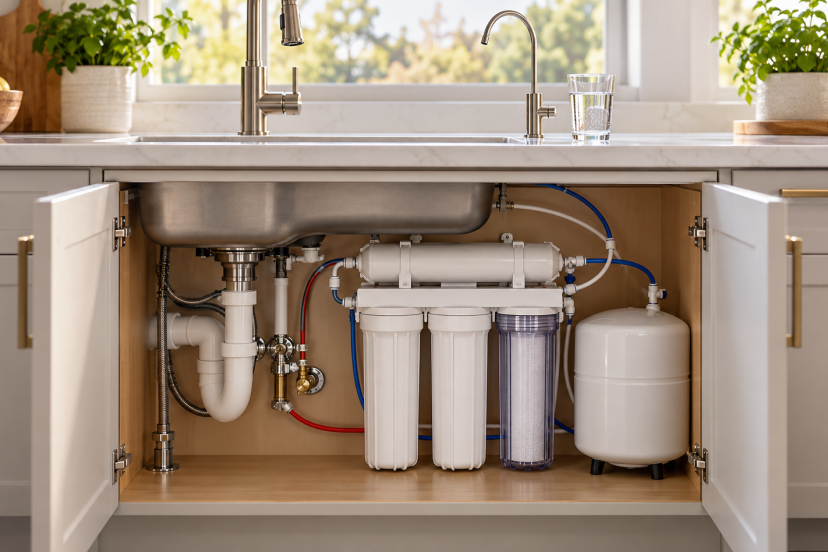
If your priority is the water you drink and cook with, treating a single kitchen faucet may be more practical than treating every gallon entering your home. APEC describes the ROES-50 as a five-stage, 50-gallon-per-day under-sink reverse-osmosis system.
Plan space for its storage tank and dedicated faucet. Installation also requires a drain connection, and reverse osmosis sends some water to the drain during filtration.
Key features: Five-stage under-sink RO with a storage tank
Best for: Dedicated drinking and cooking water
Pros: Focused treatment; established replacement-filter range
Cons: Uses cabinet space; requires faucet and drain connections
Why we recommend it: It directs your filtration budget toward the water your household consumes most directly.
9. Waterdrop G3P600 — Best Tankless Under-Sink RO

A storage tank can take over a small sink cabinet. The G3P600 avoids that bulky component, making it appealing when you want a dedicated RO faucet but need to preserve space for cleaning supplies or bins.
Confirm that you have an electrical outlet, suitable drain access, and room for future filter changes. Its model-specific cartridges should be included in your long-term cost comparison.
Key features: Tankless reverse osmosis and dedicated faucet
Best for: Kitchens with limited under-sink space
Pros: No storage tank; compact arrangement
Cons: Needs electricity; proprietary replacements
Why we recommend it: Its layout makes under-sink RO more workable in a crowded cabinet.
10. AquaTru Classic — Best Countertop RO

Renters and homeowners who cannot modify plumbing still have options. AquaTru Classic sits on the counter and uses removable containers, so you can get RO-treated drinking water without installing a separate faucet.
The everyday trade-off is hands-on work: fill the source tank, empty the waste container, and leave enough counter space for the unit. Check the precise model’s certified reduction claims against your water concerns.
Key features: Countertop reverse osmosis without plumbing changes
Best for: Renters and kitchens without under-sink installation space
Pros: Portable; no dedicated faucet or drain connection
Cons: Manual refilling; occupies counter space
Why we recommend it: It makes RO accessible when a permanent installation is off the table.
How to Choose a Household Water Filtration System
Start with the water, then choose the equipment. Visible sediment points toward a particulate filter. Chlorine taste or odor may call for carbon filtration. A well-water result showing iron requires equipment rated for that water chemistry. The EPA’s home water-treatment selection guide explains how to match treatment to the concern.
Decide where filtration is needed. A point-of-entry system treats water for the whole home, which can be useful when showers and appliances are part of the problem. A point-of-use system treats water at a particular faucet and may be the more economical choice when drinking water is your main concern.
Check the exact reduction claim. NSF/ANSI 42 addresses specified aesthetic issues such as chlorine taste and odor. Standard 53 covers specified health-related contaminant claims, while 58 applies to reverse-osmosis systems. A product certified to a standard is not necessarily certified to reduce every contaminant within that standard.
Finally, budget beyond the purchase price. Allow for installation, replacement filters, adequate flow, and clearance to service the system. If you are planning other plumbing upgrades, this guide to electric tankless water heaters can help you consider the space and installation work involved.
Final Thoughts
The best household water filtration system matches a documented water problem and fits the way you use water at home. The iSpring WGB32B is our strongest general whole-house pick for sediment and chlorine-related concerns; the APEC ROES-50 is a compelling choice when drinking water is the priority. For iron, well-water issues, or a named contaminant, let test results and verified performance claims make the final decision.
FAQs
Is a whole-house filter better than an under-sink filter?
Neither is automatically better. Whole-house filtration treats water entering the home, while an under-sink unit treats water at one faucet. Choose based on where the problem occurs.
Does a whole-house water filter soften hard water?
Most sediment and carbon filters do not remove the minerals responsible for hardness. Water softeners use a different treatment process.
Which water-filter certification should I look for?
Look for a certified claim covering the specific contaminant you want reduced, then confirm it applies to the exact model and cartridge you plan to buy.
Can a filter make unsafe well water safe to drink?
Do not assume it can. Test the water first, select treatment suited to the results, and verify that the treated water meets your needs.
How often should I change the cartridges?
Follow the schedule for your exact model and cartridge. Heavy sediment, high water use, or reduced flow may call for more frequent changes.