Best Landscape Lighting for a Beautiful Yard
We may earn a commission for purchases made using our links. Please see our disclosure to learn more.
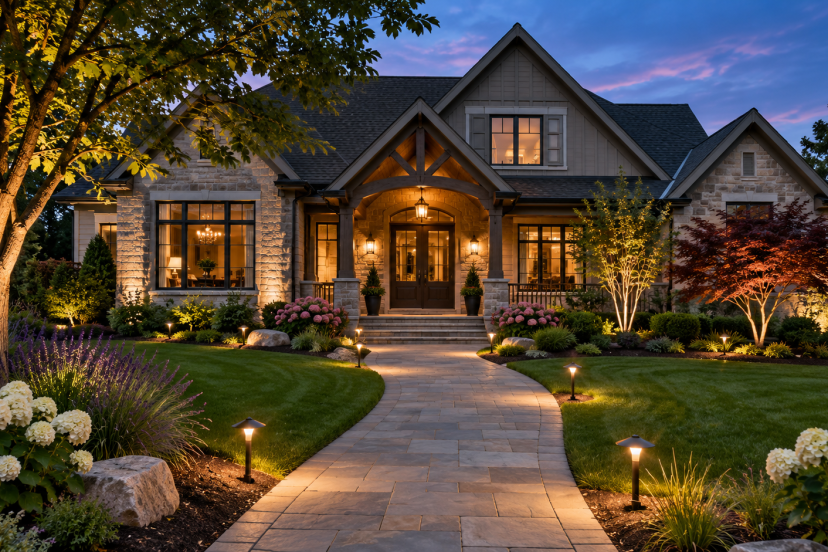
Landscape lighting can completely change how a yard feels after sunset, but the best setup is not the one with the most fixtures. It is the one that guides people safely, highlights the parts of your landscape worth seeing, and adds atmosphere without flooding the property with harsh light.
For most homes, that means combining a few types of outdoor lights rather than buying one large matching set and placing fixtures everywhere. Path lights can define walkways, spotlights can reveal trees or architectural details, and low-level hardscape lights can make steps and retaining walls easier to navigate.
What Makes Landscape Lighting Worth Buying?
Good landscape lighting has two jobs: improve function and improve the look of the yard. A fixture should solve a specific problem, such as lighting a step, defining a path, highlighting a tree, or making a patio more usable at night.
The U.S. Department of Energy’s guidance on energy-efficient exterior lighting notes that LED exterior lighting offers strong efficiency and control advantages, while automated controls can further reduce unnecessary energy use. For a home landscape, that makes LEDs a practical default for most new installations.
DarkSky International and the Illuminating Engineering Society recommend outdoor lighting that is useful, targeted, low-level, controlled, and warm-colored in their Five Principles for Responsible Outdoor Lighting. That advice is especially useful in residential yards because brighter is not automatically better. A carefully aimed warm light usually creates more depth than a broad floodlight pointed across the lawn.
Choose the Right Type of Landscape Lighting
Path Lights
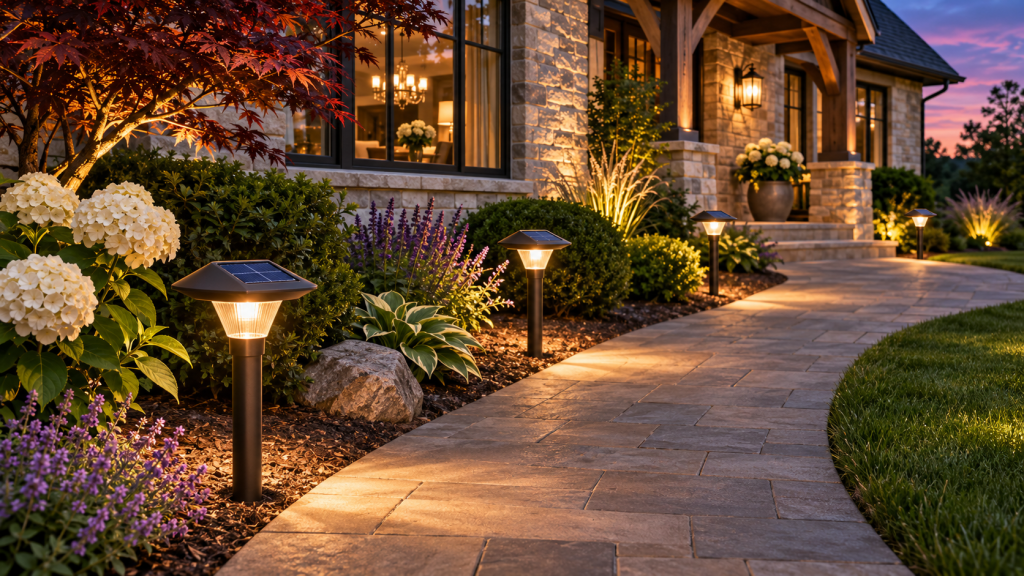
Path lights work best along walkways, garden edges, and approaches to steps. Space them far enough apart to create a gentle rhythm rather than a continuous runway effect.
Look for fixtures with shields or downward-facing heads. They put light where feet actually need it and reduce glare when you look across the yard.
Spotlights and Uplights
Use spotlights when you want to feature a tree trunk, textured wall, specimen plant, column, or other focal point. Adjustable heads are helpful because you can fine-tune the beam after installation.
Avoid aiming several bright spotlights at every plant. Pick one or two strong focal points and let darker areas remain between them. Contrast helps create dimension and visual interest in a landscape after dark.
Hardscape and Step Lights
Hardscape lights mount under caps, ledges, railings, retaining walls, and steps. They are a smart choice when you want the light source to stay visually quiet.
Because the fixture is tucked into the structure, the effect feels integrated rather than added on. They are particularly useful around stairs, outdoor kitchens, seating walls, and raised patios.
Solar Lights
Solar landscape lights are easy to install because they do not need buried cable or a transformer. They make sense for sunny areas, temporary layouts, smaller gardens, and locations where wiring would be inconvenient.
Their main limitation is consistency. Shade, battery condition, and panel orientation can affect output, so use solar lighting mainly for ambience and basic wayfinding.
Low-Voltage vs. Solar Landscape Lighting
For a permanent front yard or professionally styled landscape, low-voltage lighting usually gives you more control over brightness, spacing, fixture choice, and beam direction. A transformer reduces household voltage before power reaches the landscape system, and fixtures can be connected along low-voltage cable.
Solar is simpler and often cheaper to install. It is ideal when you want a fast DIY upgrade with no trenching. If your yard has heavy shade or you want dependable illumination around steps and primary walkways, wired low-voltage fixtures are usually the stronger long-term choice.
Pick a Warm Color Temperature
Warm white light generally feels more natural around wood, stone, brick, plants, and traditional home exteriors. Around 2700K to 3000K is a useful range for many residential landscapes.
Cooler light can work for certain modern designs, but very blue-white lighting can look stark outdoors. DarkSky also recommends warmer colors where possible to limit unnecessary short-wavelength light.
Pay Attention to Beam Direction, Not Just Brightness
Lumens tell you how much light a fixture produces, but they do not tell you how well that light reaches the intended surface. A lower-output fixture with a controlled beam can be more useful than a very bright lamp that throws light in every direction.
Before buying, decide what each fixture will illuminate. Path lights should direct light down. Uplights should have enough adjustment to hit a tree or wall without shining into windows. Step lights should illuminate the walking surface without sitting directly in your line of sight.
Check Weather Resistance and Construction
Outdoor fixtures live in rain, irrigation spray, soil, heat, cold, and humidity. Look for products clearly rated for outdoor use and check the manufacturer’s ingress-protection information when available.
Make sure connectors, cable joints, and transformers are also designed for outdoor installation.
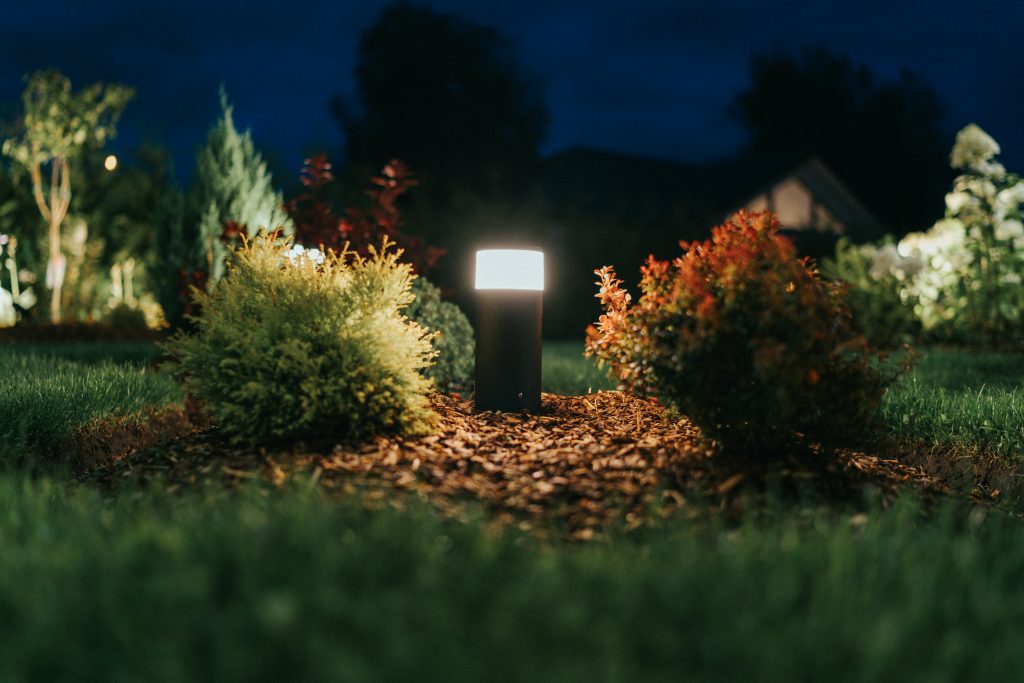
Best Landscape Lighting Products
These five options cover different yard layouts and installation styles, so you can choose based on how you plan to use the light rather than simply buying the biggest kit.
1. SUNVIE 12-Pack Low Voltage Pathway Lights — A practical choice for homeowners who want warm 3000K wired path lighting. The set uses 3-watt LED fixtures with shielded heads designed to reduce direct glare, making it well suited to walkways, garden borders, and front-yard approaches.
2. GIGALUMI 12-Pack Solar Pathway Lights — A simple no-wire option for garden paths, patios, and decorative borders. The lights use warm-white LEDs and solar charging, making them most useful where the panels receive strong daytime sun.
3. LEONLITE 8-Pack 7-Inch LED Hardscape Lights — Designed for retaining walls, steps, masonry edges, and similar built-in applications. The low-voltage fixtures provide warm 2700K light and are useful when you want illumination to appear from the structure instead of from a visible stake light.
4. Philips Hue Lily Outdoor Smart Spotlight Base Kit — A premium option for smart accent lighting. The three-light base kit can highlight trees, walls, and landscaping with adjustable white or colored light, and it works with the Hue smart-lighting ecosystem for app and automation control.
5. Ring Smart Lighting Pathlight Battery — A good fit for homeowners who want motion-activated path lighting without running cable. It is battery powered and can connect with compatible Ring smart-lighting features for automation and device coordination.
For more ideas on coordinating lighting with the entrance and planting, see these curb appeal ideas for a beautiful front yard.
Conclusion
The best landscape lighting combines safety, atmosphere, and restraint. Start with warm, targeted light along paths and steps, then add a few accent fixtures for trees, walls, or other focal points. For most permanent projects, low-voltage LED lighting gives you the strongest mix of control and reliability. Solar fixtures are a convenient alternative for sunny areas and easy DIY upgrades. Before ordering a full set, map the yard at night and decide exactly what each light needs to do.
FAQs
How many outdoor lights does your yard need?
There is no ideal fixture count. Start with entrances, steps, main paths, and one or two focal points, then add more only where the yard still needs light.
Should you choose 2700k or 3000k outdoor lighting?
Both work well for residential landscapes. Choose 2700K for a softer, warmer effect and 3000K for a slightly crisper warm white.
Are solar landscape lights worth it?
Yes, when they receive enough direct sunlight and you mainly want ambience or basic path marking. For dependable brightness in shaded areas, wired low-voltage lighting is usually more consistent.
Can I install low-voltage landscape lighting myself?
Many homeowners can install simple low-voltage systems, but the transformer, load, cable size, connections, and local electrical requirements still matter. Follow the manufacturer’s instructions and use a qualified electrician when the project involves line-voltage work or you are unsure about the electrical setup.
Should landscape lights stay on all night?
Usually not. Timers, dusk-to-dawn controls, smart schedules, and motion sensors can reduce unnecessary operating time while keeping light available when you actually use the yard.